
What the Research Got Right About School and Community Partnerships — And What I’ve Seen With My Own Eyes
A reflection by Tracey Beal, Founder & CEO, School Connect
When faith communities, businesses, nonprofits, and neighborhood organizations engage with public schools — not casually, but strategically — students do better. Schools are stronger. Communities are more connected. This isn’t just a hopeful idea. Now it’s documented by research.
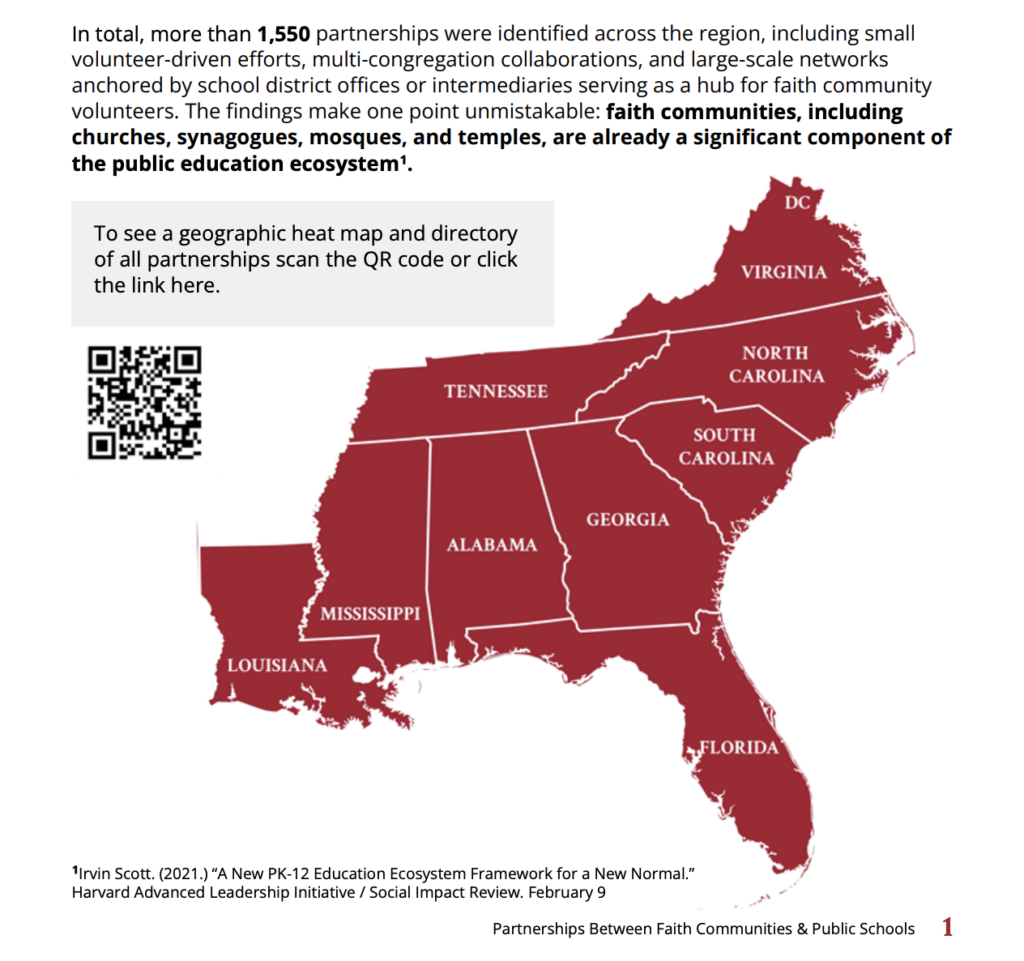
A March 2026 landscape report commissioned by The Leadership Initiative for Faith & Education (LIFE) at Harvard Graduate School of Education studied more than 1,550 faith-school partnerships across nine Southeastern states. The findings confirm what I have long known: faith communities are already a significant component of the public education ecosystem, and the potential for even greater impact is enormous. When community partners are fully engaged — and engaged strategically — it makes a measurable difference for kids.
I’ve spent my career building exactly these kinds of partnerships in Arizona and beyond. And reading through this research, I kept thinking: yes. This is what we’ve seen with our own eyes. Now here’s the proof!

Schools Left Alone Don’t Thrive the Way Schools That Are Supported Do
And because both public schools and faith communities serve as anchors for their communities, there is significant opportunity for systemic growth.
The researchers capture something I believe deeply:
“Faith communities and public schools share commitments to children that can strengthen learning when efforts are coordinated.”
What I especially appreciate is that the research also identifies the gaps — coordination, infrastructure, and accessible support. Those three words describe exactly the problem that organizations like School Connect exist to solve. Goodwill is abundant. Structure is what’s missing. And that gap between goodwill and impact is where so many partnerships stall out.
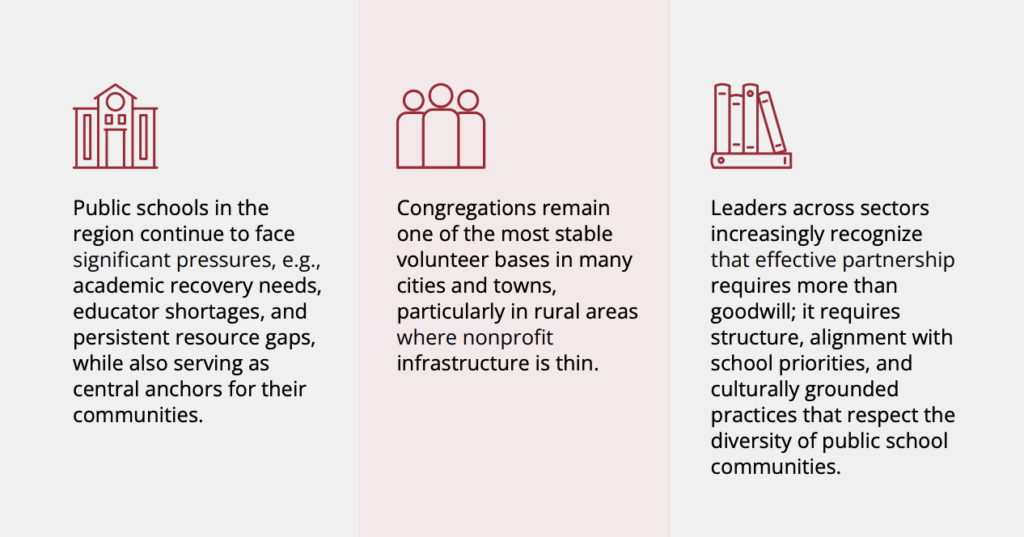
Three Things Every Effective Partnership Needs
The researchers put it well: “Leaders across sectors increasingly recognize that effective partnership requires more than goodwill. It requires structure, alignment with school priorities, and culturally grounded practices that respect the diversity of public school communities.”
When I read that, I thought — yes. That is the School Connect model.
Here’s what each one looks like in practice.
Structure: A Clear Pathway for Partners
The first challenge is the tendency to be siloed. Everyone is working so hard and so fast that they don’t build trusted relationships or ask each other how they can actually work together. And without a framework — a clear, simple pathway — the goodwill never converts into anything strategic.
What I found early on is that you have to get buy-in at the district level first. When the district understands the vision and the process, it opens the door for principals. And through training, coaching, and relationship-building, everyone has clarity on shared goals, the specific ways community partners can be involved, and the role everyone plays.
Here’s a real example of what that looks like.
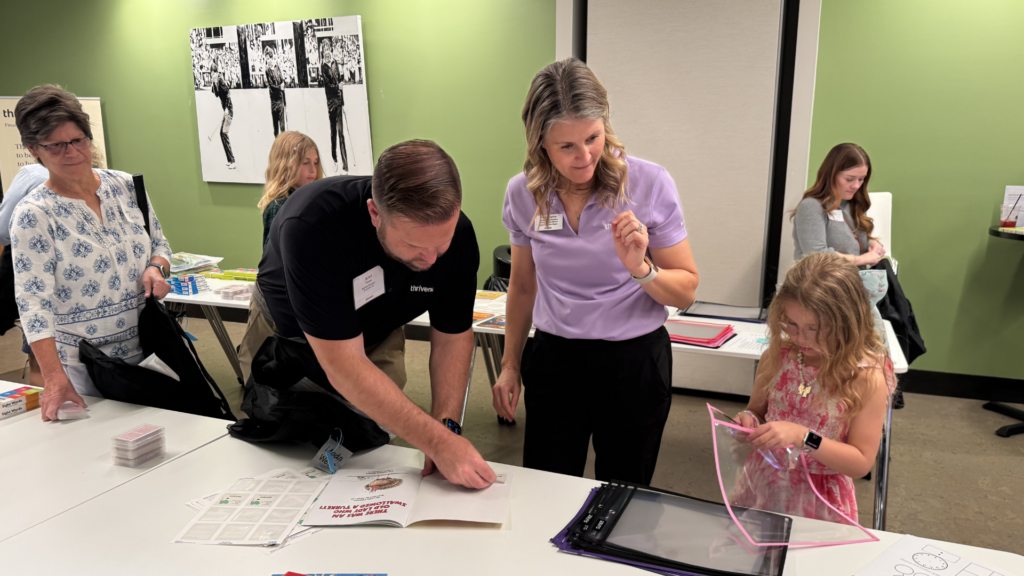
At a recent CAFE including Larkspur Elementary — a Title I school in the Paradise Valley School District — the people around the table included school leaders, someone from a local church, and a representative from Thrivent Financial. As the conversation unfolded and the school’s needs became clear, everyone started connecting the dots. After the CAFE, leaders from Thrivent realized they were already planning their annual member celebration — a fun event at a local putting course — and their members wanted to build in a meaningful way to give back as part of the day. Soon, the idea came together.
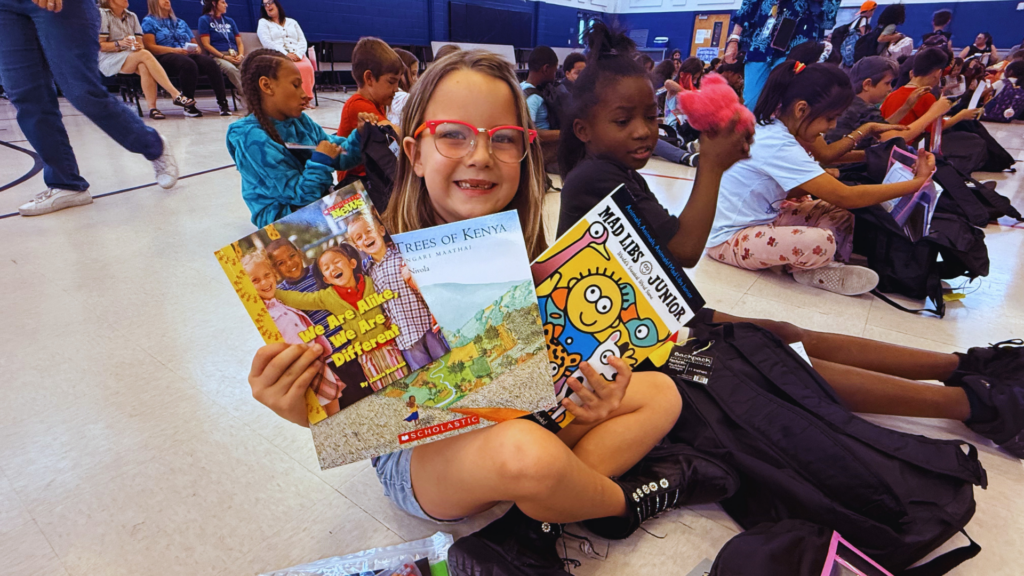
The teachers made a list of what the kids needed going into summer. At the event, Thrivent members assembled 150 backpacks, each packed with supplies, totaling about $100 per backpack. The principal came. The assistant superintendent for elementary education came. Every item in those backpacks came directly from the teachers’ requests.
That’s the CAFE model working exactly as it’s designed to — putting the right people in the same room, around the same table, so that what each of them has to offer lines up with what the school actually needs.
Alignment With School Priorities: Ask Before You Act
The research highlights one of the most powerful insights I’ve seen play out over and over: the partnerships that work best start by asking the school what it needs — not by arriving with an agenda. In the research, Heart4Schools in South Carolina built their entire model on this. Their leader says, “What really changed everything was deciding that our role was not to tell schools what we wanted to do, but to ask them what they needed. We go in with no agenda other than to serve.”
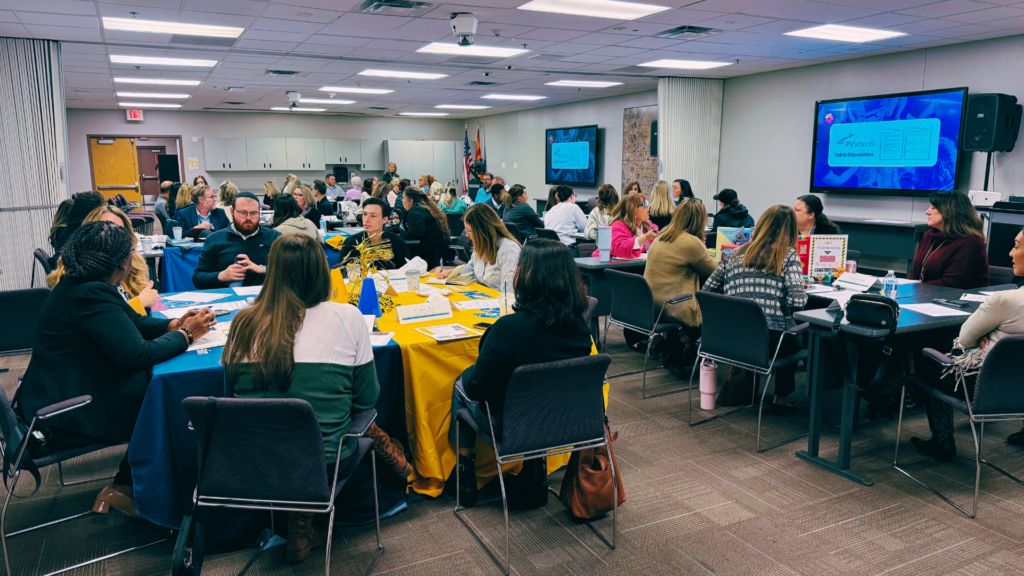
This is exactly how our CAFE model works, too. A CAFE — Community And Family Engagement — is a gathering of principals, school staff, faith leaders, business leaders, nonprofit leaders, parents, and neighborhood partners sitting down together to listen, build trust, and design practical ways to support students and families. But it only works because the school has already done the hard work of naming its goals and priorities for community engagement first. Partners don’t show up and ask, “What would you like us to do?” They hear, “Here’s where our students are struggling, here’s what we’re working toward, and here are specific places where your strengths could make a real difference.”
That alignment changes everything. When a school in the Washington Elementary District needs household items for families, CalvaryPHX and Pure Heart Church are already set up as distribution points — food, counseling, support for families navigating crisis. Those families now have a bridge to what they need. When a school is building a game room to support positive student behavior, the resources to outfit it can come from a faith community right around the corner. None of that happens by accident. It happens because someone asked, and someone listened.
Culturally Grounded Practices: Strengthen, Don’t Solve For
This is the one I feel strongly about, and I’m glad the research addresses it directly. The report found that most partnerships tend to be religiously, racially, or economically homogeneous relative to the school communities they serve, and calls this out as a challenge the field must address.
Here’s why it matters: when well-resourced communities send volunteers into schools without taking time to understand the community they’re walking into, even the best intentions can miss the mark. Instead of empowering and strengthening the community that’s already there, volunteers — in their genuine good intention — can inadvertently try to solve problems for the community rather than with it. That’s not partnership. That’s charity. And there’s a real difference.
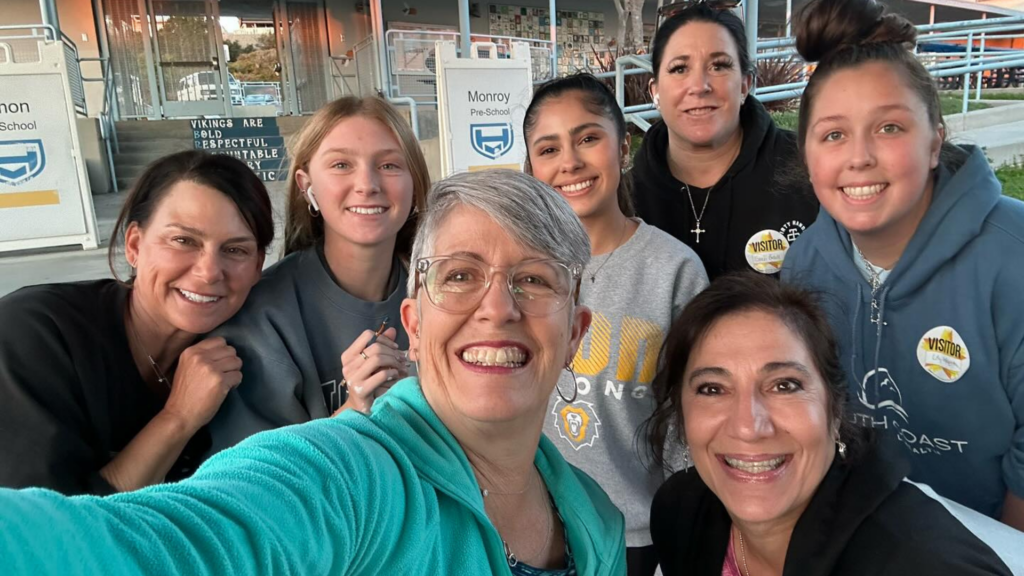
What this work must be about is making sure that the faith communities and partners closest to the school have the loudest voice — that they reflect the community.
The Intermediary Multiplier — And Why It Matters for Rural Communities Too
That’s the moment the fulfillment of something a school leader had always wanted finally came to life.
Communities with intermediaries like School Connect— nonprofits that organize and coordinate partnerships between congregations, community leaders, and school districts — achieved far more scalable, sustainable, and academically impactful outcomes than those without intermediaries. These organizations build district relationships, provide training, and create shared spaces where schools and partners can work together consistently. Without one, navigating the school system is genuinely hard for most congregations and local volunteer organizations.
This is true across the board, whether the school is in an urban, rural, or tribal setting. One of the findings that struck me most was about rural communities. When a strong intermediary is present, rural faith communities can deliver academic programming on par with urban ones. Without structure, rural partnerships tend to stay focused on immediate needs — not because rural congregations lack willingness or capacity, but because they don’t have the infrastructure to go deeper.

Here’s what that looks like for School Connect.
In January, I drove down to Cochise County — Bisbee, Tombstone, Elfrida, Sierra Vista — communities stretched across a rural landscape where districts can be an hour and a half apart. I spoke to 40 pastors who wanted to serve their local schools. Then I met with 25 business leaders who felt the same pull. The desire was absolutely there. What those communities needed was someone to come in and say: here’s how we organize this, here’s how we connect you to your schools in a way that actually works, here’s the structure that turns your willingness into something the district can count on. This fall, we plan to host district-wide CAFEs to bring everyone to the table and discuss how we can work together.
It was a true success! Through hard work, so much fun, we discovered we can build unity through community service. Here’s everything we accomplished together:
That’s what an intermediary does in a rural setting. It doesn’t bring willingness — the community already has that. It provides the framework that turns willingness into impact.
When You Connect Volunteers to Proven Programs, Academic Outcomes Improve
The partnerships with the strongest academic results were the ones connected to established programs — tutoring models that already existed, with training, materials, and a way to measure progress. Volunteers had clarity. Teachers trusted them. Kids got consistent, aligned support. And volunteers who might have been intimidated by tutoring were willing to participate once they had a proven method behind them.
I’ve seen this firsthand through Terrilee Stevenson’s leadership of School Connect in Orange County. She spent time trying to convince the district to allow community volunteers to read with kids in its literacy program as part of the district’s regular school operations. At first, the district was cautious about letting community members participate. So, Terrilee asked them to pull the data: what’s the percentage of change in these specific kids after this program? The results were dramatic. There was no denying that the program improved literacy. Now literacy is a regular part of her work with the district, and she’s helping them scale with more support.
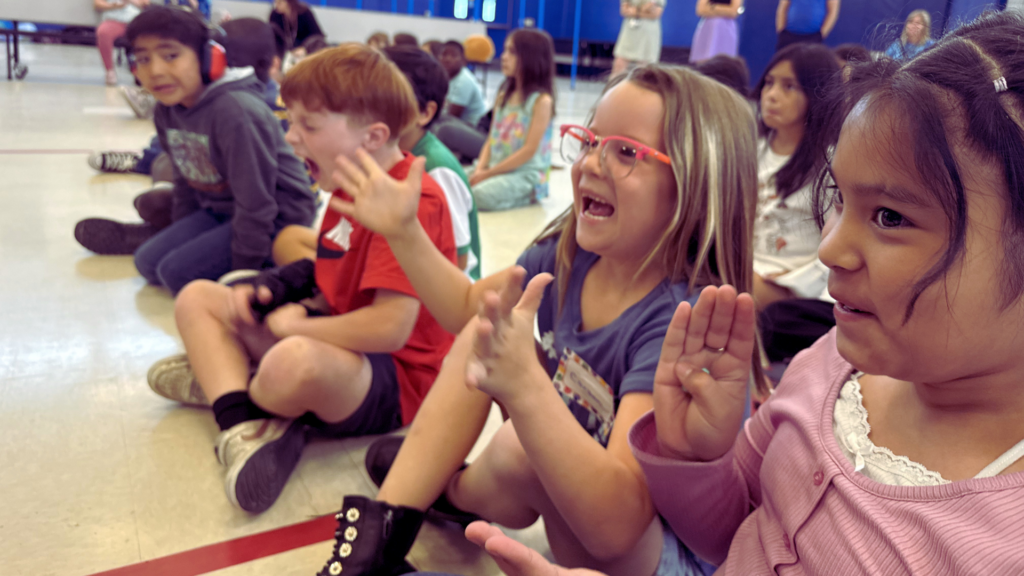
That is exactly what happens when you fill the pipeline with a proven program and connect the right volunteers to it. Third-grade reading. Eighth-grade math. Language learning. Partnerships genuinely move the needle. Many faith communities already have the volunteers. The schools have the goals. The proven programs already exist. When all three come together — through structure, alignment, and trust — positive change happens for kids.
What Should We Be Measuring Together
If you’re a school leader in Arizona who has watched something like this from a distance and thought, I’ve always wanted to do something like that — I want you to know: you’re not alone, and there is a pathway.
The research found that 57% of faith-school partnerships don’t track effectiveness at all — they count activities rather than outcomes. Things like hours volunteered. Snacks provided. Books distributed. And the study is honest about why: congregations are motivated by faith and by the act of showing up. Simple impact tracking tools aren’t necessarily available or accessible.
I understand that. But I think the measurement question goes beyond what faith communities are tracking. Schools, districts, and community partners all need to be asking: What are we actually trying to accomplish? And how do we know if we’re getting there?
Here’s what I’ve seen work.
When Terrilee asked the district to show her the impact on the students in the literacy program, it changed the whole relationship. The district went from cautiously permitting the work to actively investing in it. Because now they could see it. And partners went from feeling like they were showing up, hoping for the best, to knowing they were part of something that was genuinely moving the dial.
In Closing: Building Trusted Relationships Removes Barriers & Improves Outcomes for Kids
But first, you need a system. You need a framework that helps schools and partners work together over time — one that builds communication, creates accountability, and makes the work sustainable. If your district has the capacity to build that internally, wonderful. But if there’s an organization like School Connect in your community, connect to it. We exist precisely to open those doors, remove those barriers, and help all that goodwill become strategic.
This work isn’t just about making sure kids have food and clothing and feel safe — though we absolutely want all of that. Community partners can also help move the dial on attendance, third-grade reading, eighth-grade math, student behavior, teacher retention, and parent engagement. These things can and do change when we work together.
It really does take a village. Let’s build it together.